


The Arts Council Funds a Wake Forest Pilot Study: Prescribing Arts as a Tool in Forsyth County
The Arts Council funded an Arts on Prescription pilot study which allows physicians to prescribe dance, music, art or creative writing experiences as a social behavior that can improve their health and wellbeing.
This innovative project brings together leadership from the Intergenerational Center for the Arts and Wellness at Senior Services, Inc, the Arts Council of Winston-Salem and Forsyth County, Wake Forest University School of Medicine and independent teaching artists.
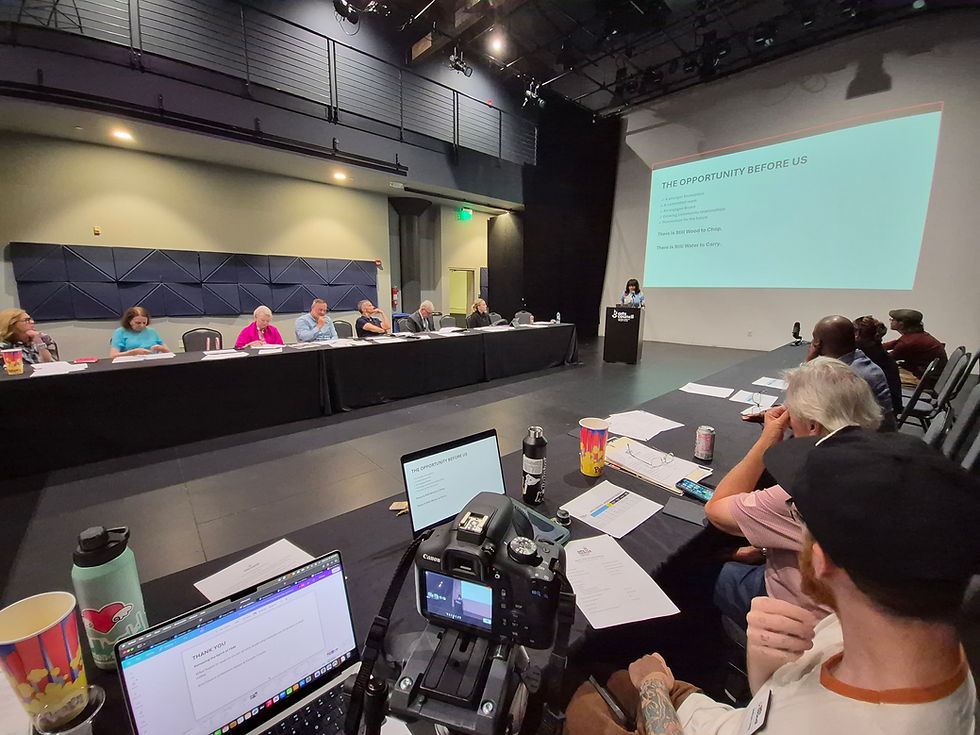
On Friday, February 13, we heard about findings from the pilot study and learned about the Arts Rx Program at the New Jersey Performing Arts Center that inspired the project at the Arts, Health Care and Humanities in Action symposium.

Shannon B. Henry greeted the audience.
Shannon B. Henry's Arts, Health Care, and Humanities in Action Symposium Speech:
I am newly stepping into the role of President & CEO, and I could not imagine a more meaningful gathering to stand before you for one of my first public welcomes. Today represents exactly the kind of work that defines who we are as a city, and who we are becoming.
Winston-Salem is the “City of Arts and Innovation.” But today, we are not just celebrating that identity, we are expanding it.
This symposium builds on the momentum of national efforts like One Nation/One Project, which reminded us that the arts are not a luxury, they are a necessity. They are civic and public health infrastructure.
You will hear more about Winston-Salem’s & the Arts Council’s role in that national movement during today’s first panel discussion, represented by Shannon Stokes. Winston-Salem was selected as one of the original national cohort sites uniting civic leaders, artists, and community health providers around arts-driven healing and resilience.
That spirit of collaboration continues in this Arts on Prescription initiative.
The Arts Council was proud to fund the early development of this work, not simply as a grant, but as an investment in partnership. Today’s symposium is a direct extension of that investment. It reflects our shared understanding that the arts and healthcare must work together, and our broader commitment to advancing equitable access to creative practice.
As we gather today, we are building the case, locally and across North Carolina, for expanding funding mechanisms that recognize the arts as a legitimate, measurable component of health and wellbeing.
As I reviewed the vision brought forward for this initiative, I was struck by its ambition. It brings together artists, physicians, researchers, community leaders, and elders in our community to ask bold questions:
What if we prescribed connection? What if we prescribed creativity? What if we prescribed belonging?
And one line in particular stayed with me. The World Health Organization defines “health” not merely as the absence of disease, but as the capacity to thrive.
Too often in healthcare, and frankly in life, we focus on survival. But thriving requires something more. It requires connection, meaning, and expression. This work is grounded in research, including remarks from the U.S. Surgeon General, reminding us that loneliness can be as harmful to one’s health as smoking up to 15 cigarettes a day. That should stop us in our tracks.
This pilot acknowledges something simple but profound: The arts and sciences are not separate hemispheres of our community, just as they are not separate hemispheres of our brain. I often like to say that we are not whole as human beings if we are not engaging both sides of our brain. Science helps us discover and understand the body. The arts help us understand the human experience inside that body, and help us imagine solutions science has not yet uncovered. And when arts communities and science communities work together, we move from treating illness to cultivating wellness.
This pilot reflects a collective recognition across sectors: That creative practice is not extracurricular, it is central to human dignity. But designing a pilot is one thing. Making it accessible is another. Accessibility means ensuring that elders across our zip codes see themselves reflected in these opportunities. This is why this pilot matters. It studies our local context. It listens before it scales. It measures what matters such as social connectedness, reductions in loneliness, and improvements in well-being. It does not assume. It learns.
And from that learning, we build sustainable funding models, locally and across North Carolina, that allow physicians to confidently prescribe the arts as part of holistic care.
As the Arts Council, we see our role clearly.
We are funders. We are advocates. We are conveners. And increasingly, we are partners in building systems where arts and health intersect intentionally. This is part of our broader commitment, to invest in work that strengthens the social fabric of Forsyth County.
& personally, this work resonates deeply with me.
Through my own experiences with grief, I have come to understand, not just intellectually, but viscerally, the healing power of dance, music, storytelling, and creative expression. I have seen how isolation can quietly erode vitality. And how connection can restore it. That realization carries responsibility. And I admire the sense of responsibility that Christina and so many of you bring to this work, that because we have the partnerships, because we have the Generations Center, because we have Wake Forest University’s research leadership, because we are the City of Arts and Innovation, we are obligated to try and we are poised to lead.
Today is not the conclusion of a pilot. It is the continuation of a commitment, to move from surviving to thriving, to advance health equity, and to ensure access to the arts is not a luxury, but a pathway to wellness.
On behalf of the Arts Council of Winston-Salem & Forsyth County, thank you for being here. Thank you for your scholarship, your artistry, your advocacy, and your willingness to move beyond the boundaries that have historically separated arts, health, and public life.
The future of arts and health in Forsyth County is not theoretical.
It is sitting in this room.
Welcome, and I’m excited to continue the work.

If you would like to support the arts via the Arts Council, please consider joining us as a donor today. Click here to join.


Mình có lần lướt đọc mấy trao đổi trên mạng شيخ روحاني thì thấy nhắc nên cũng tò mò mở ra xem thử cho biết. Mình không tìm hiểu sâu جلب الحبيب chỉ xem qua trong thời gian ngắn để quan sát bố cục جلب الحبيب cách sắp xếp شيخ روحاني các mục và trình bày nội شيخ روحاني dung tổng thể. Cảm giác là các phần được trình bày khá gọn, các Berlinintim mục rõ ràng nên đọc lướt cũng không bị rối Berlinintim với mình như شيخ روحاني vậy là đủ để nắm tin cơ bản rồi. جلب الحبيب
👍
Números Calientes Y Fríos ofrece contenido interesante. También disfruté esta reseña por su reflexión profunda sobre la vida, la memoria y la aceptación. ¡Excelente recomendación de lectura!
DG Club login was quick and easy. The game offers great entertainment with interesting features and levels. I’ve been playing daily and it keeps getting more engaging every time.
Paglu Game download was quick and easy. The game offers great entertainment with interesting features and levels. I’ve been playing daily and it keeps getting more engaging every time.
I work with arts and wellness programming myself, so the detail that physicians in Forsyth County can now prescribe dance or music lessons the same way they'd write a scrip for medication really stood out to me — it's exactly the kind of real-world crossover we've been exploring in narrative spaces at https://tuoverse.com, and I'm curious how the prescribed creative writing sessions compare to structured workshops.